

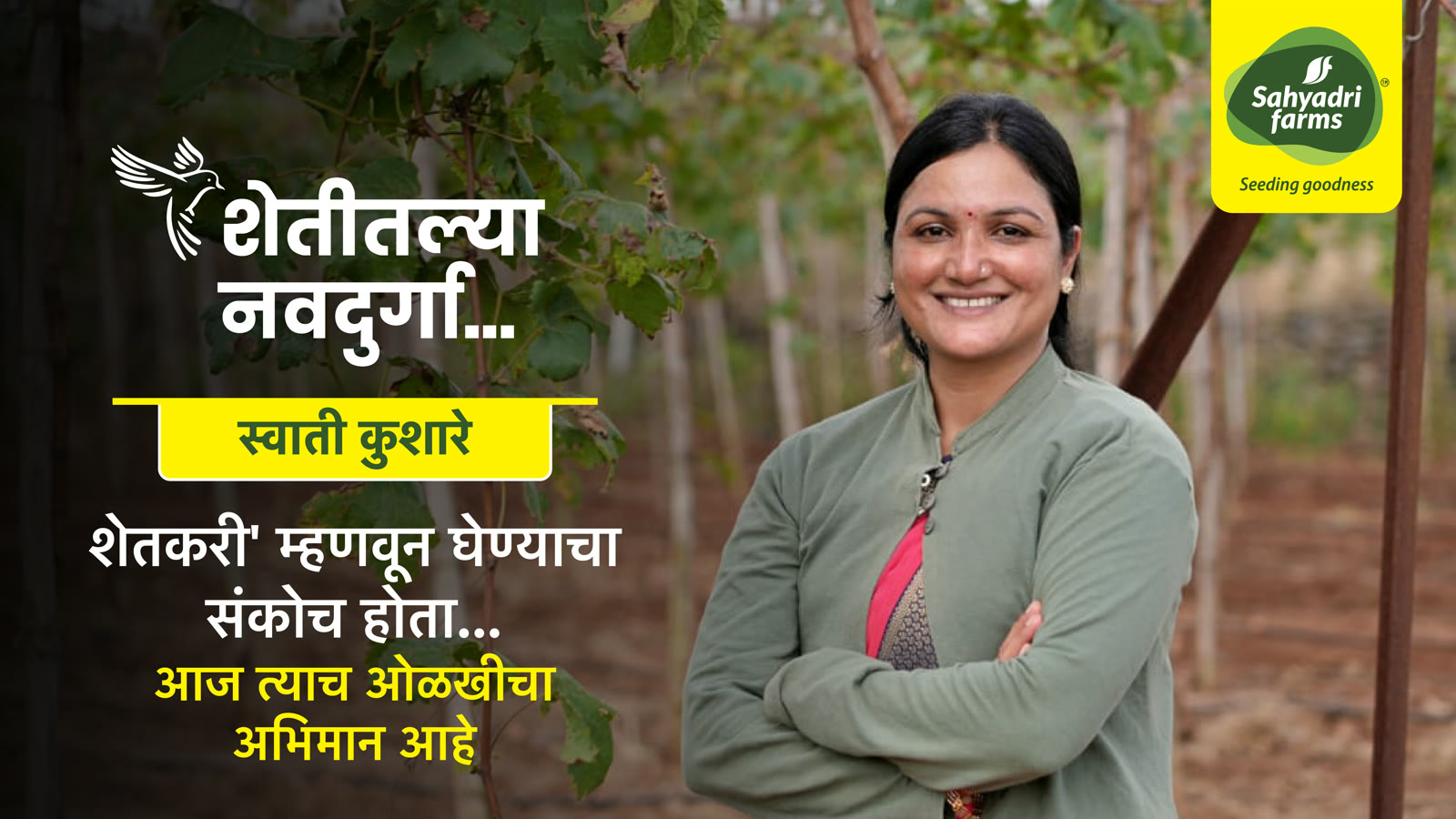
There was a time when Swati Samadhan Kushare felt hesitant to introduce herself as a farmer. Today, she proudly embraces that identity.
In 2026, from 16 acres of farmland, Swati produced 63.3 metric tonnes of grapes and earned ₹89.57 lakh. Her production has increased by 77% over the past three years. Her journey is not only about higher production and income; it is about changing the way she sees herself and farming.
Swati completed her education up to Class 12 in the Science stream. She had always wanted to pursue higher education and take up a job. After marriage, however, she became part of a farming family, and initially she found it difficult to accept that path.
When her friends began taking up jobs, she sometimes wondered if she too should have chosen a career outside farming. Gradually, however, her perspective changed.
She accepted responsibility for 16 acres of grape cultivation and began learning every aspect of farming. She studied production planning, vineyard care, markets and the use of technology. Instead of looking at farming as something that had to be continued simply because it was a family tradition, she began treating it as a business.
One important part of this transformation was the adoption of the ‘Ara’ grape variety. Today, the grapes produced on her farm reach not only local markets but also domestic and international markets. When a friend living abroad recognised the variety, Swati felt a special sense of pride knowing that grapes from her farm were reaching global markets.
According to Swati, once farming is approached as a business, it becomes easier to understand and manage. Her results reflect this change:
2024: 35.7 metric tonnes – ₹30.75 lakh
2025: 35.4 metric tonnes – ₹36.45 lakh
2026: 63.3 metric tonnes – ₹89.57 lakh
As women’s participation in farming has increased, their voices have also become stronger in decision-making through farmer producer companies. Women are increasingly being consulted, and their decisions are being given importance.
For Swati, this is not just a personal change. It represents a change in how her family views women’s role in agriculture.
Today, Swati is creating significant economic value through farming while living in her village. She encourages her two children to pursue education in the fields they enjoy and eventually consider returning to agriculture.
Her own experience has taught her one important lesson: opportunities exist in villages too. They simply need to be viewed through a business lens.
The identity she once felt hesitant about is now one she carries with pride.
Watch the video: Navdurgas of the Farm — Swati Kushare


