

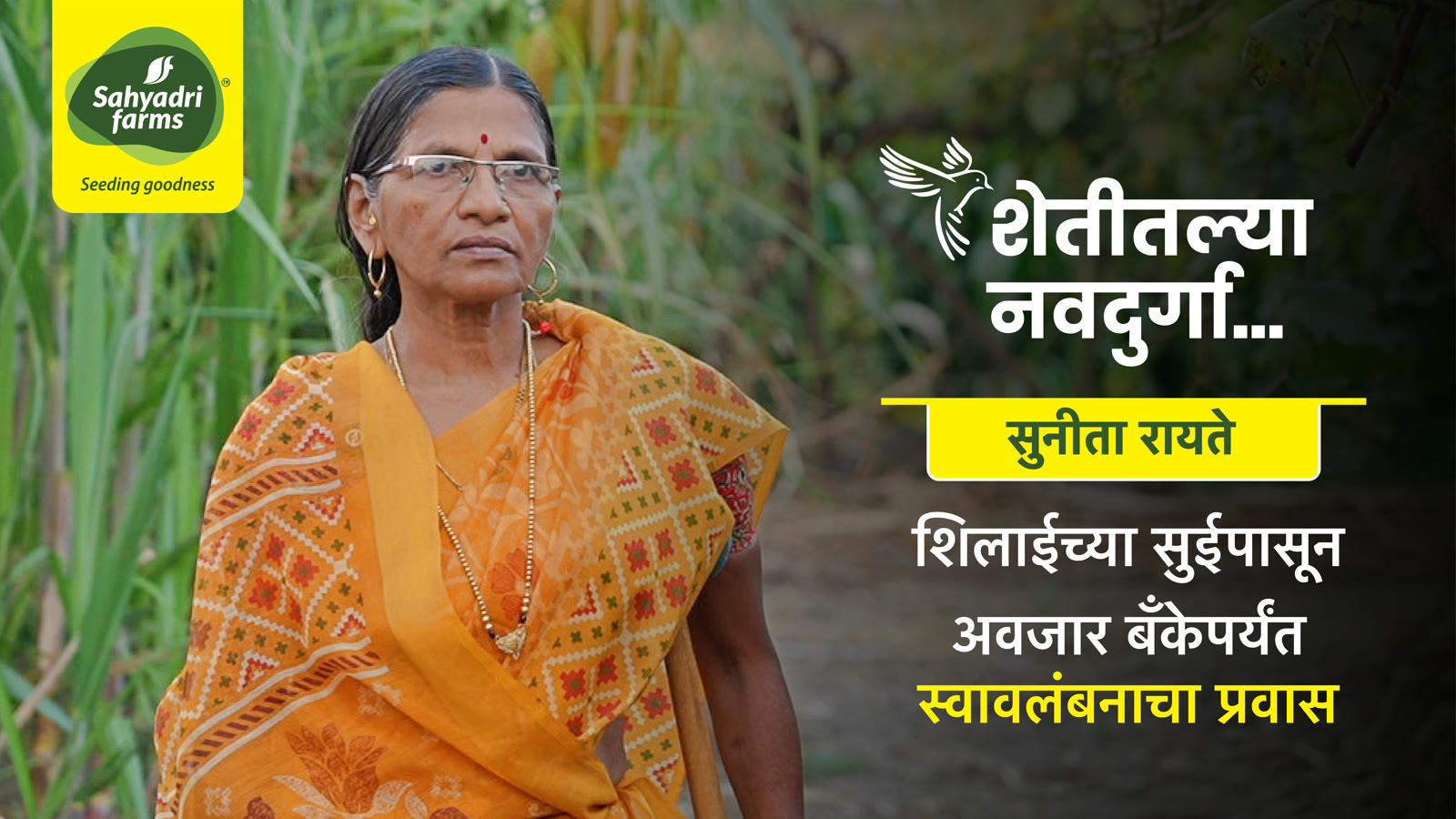
Sunita Rayate’s journey of self-reliance began not with a large business or substantial capital, but with a small sewing activity and the first three quintals of wheat she produced after solving the water problem on her farm.
Once dependent on two and a half acres of dryland farming and struggling to support her family, Sunita has today built a farm equipment bank with 70–75 types of agricultural implements. Farmers from 25–30 villages use these implements, and the initiative generates around ₹6 lakh in annual income for her.
Sunita has faced physical challenges since childhood. Polio affected her legs, and even today she uses a walking stick. However, she never allowed this difficulty to define the limits of her life.
She completed her education up to Class 12. After marriage, her circumstances changed significantly. Her in-laws’ family faced financial difficulties, both she and her husband had physical challenges, and the family depended mainly on two and a half acres of dryland farming.
Since the farm could not immediately generate enough income, Sunita started sewing after marriage. She used the income from sewing to support the household while also managing household responsibilities and farming.
Gradually, she realised that depending only on sewing and dryland farming would make it difficult to improve the family’s financial condition. Increasing farm income would require solving the water problem first. She therefore decided to drill a borewell.
After the borewell was completed, she planted wheat. In the first season, she harvested three quintals. The quantity may seem small today, but for Sunita it was the first clear result of her efforts. It gave her not only happiness but also the confidence that farming could become another source of income for the family.
She continued improving her farm through better water management, modern farming practices and hard work. Later, she developed a grape vineyard using a combination of well and borewell water. By focusing on quality production, her grapes eventually reached Russia.
While continuing her own farming journey, Sunita noticed another challenge faced by small farmers. Many could not afford to purchase agricultural implements. During the season, they often had to borrow equipment from larger farmers, and the required implements were not always available when needed.
Having experienced this problem herself, Sunita thought that if farmers could access equipment at the right time, their work would become easier—and she could also create a source of income.
This idea led to the establishment of her farm equipment bank around 2002–03. It began with a small number of implements rented out at nominal rates. Over time, the number and variety of equipment increased.
Today, the equipment bank offers 70–75 types of agricultural implements and serves farmers from 25–30 villages. It generates around ₹6 lakh in annual income.
For Sunita, the equipment bank is more than an income-generating activity. Its real purpose is to ensure that farmers have access to the tools they need when they need them, helping them complete farm operations on time and enabling small farmers to use modern agricultural equipment.
Her own difficulty became a useful system for many other farmers.
The impact has also reached her family. She supported her son’s higher education and business and encouraged her daughter-in-law to start a therapy centre.
Sunita’s story is a reminder that a challenge does not have to be the end of the road. Sometimes, when we understand the problem deeply, we can turn it into an opportunity—not only for ourselves, but for many others as well.
Watch the video: Navdurgas of the Farm — Sunita Rayate


